
Federal Way Lookup Record Range
No single roll confirms a whole identity. A Federal Way resident lookup instead matches a name against records kept for different legal purposes. The King County Assessor ties a taxpayer or owner to a parcel, while the Recorder ties named parties to recorded instruments. Court systems show dated cases. Election records have their own disclosure rules, and vital records separate public informational copies from certified proof. Business and license databases show a public role or credential, not a home address. The strongest match shares several stable details across sources.
| Record | What It Confirms | Where to Search | Access |
|---|---|---|---|
| Property roll | Owner or taxpayer, situs and mailing addresses, parcel link | King County eReal and Parcel Viewer | Public online |
| Recorded instruments | A named party's parcel connection on a given date | King County Recorder | Free index; copies may cost |
| Voter registration | Public name, address, year of birth, and voting history fields | VoteWA and election-record requests | Limited by Washington law |
| Court cases | Case number, filing court, case type, and dated events | Washington Courts and filing court | Index online; complete file from clerk |
| Vital records | Birth, death, marriage, or dissolution facts | King County, DOH, or State Archives | Eligibility varies by product and age |
| Licenses and entities | Credential, status, registered role, or filing history | State licensing boards and SOS CCFS | Public search |
Use the record that fits the fact already known. An address points to eReal. A case number belongs at the filing court. A company name or UBI belongs in the Secretary of State system. A death or marriage question belongs with the proper registrar or an archive after the release period. This keeps a resident lookup focused and reduces false matches.
Federal Way Court Name Search
Federal Way residents may appear in four court layers. Municipal matters belong to Federal Way Municipal Court, county matters can sit in King County District Court, superior matters include probate and other cases in King County Superior Court, and federal cases use PACER. The Washington Courts Case Search helps identify the court, but the filing court keeps the complete record.
| Search control | Use | Key detail |
|---|---|---|
| Court level | Municipal/district, superior, or appellate | Select before searching |
| Search type | Name, case number, or business | Required choice |
| Court and case type | Narrows the filing system | Required for most searches |
| Year filed | Separates same-name results | Use a plausible range |
| First, middle, last | Person search | Middle name is optional |
| CAPTCHA | Allows submission | Required |
Try hyphenated and spaced names separately. Odyssey permits wildcard searching within its minimum character rules. King County Superior Court also offers comparison operators such as starts with, contains, and soundex. An exact case number is better than a name once it is known.
The image below comes from the official Washington Courts search.
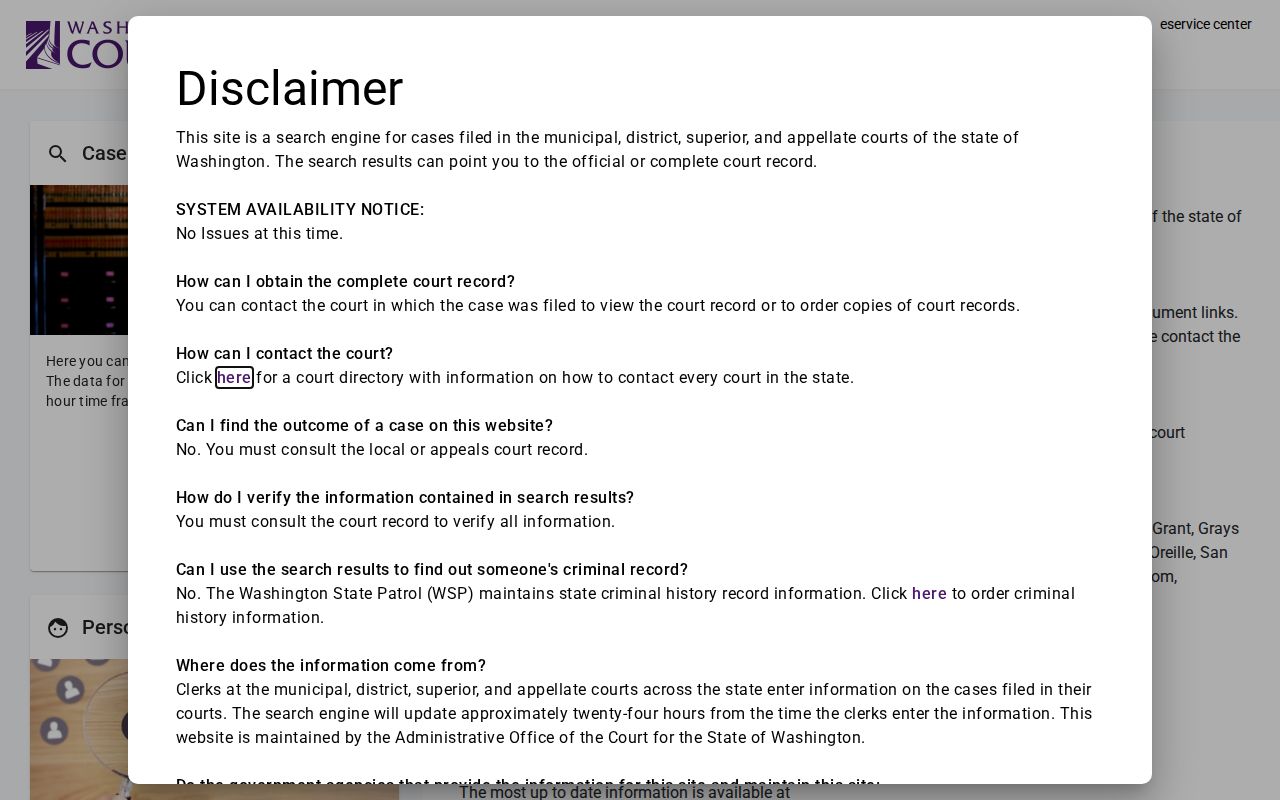
Its separate court-level choices show why a statewide result is a locator rather than the complete case file.
Confirming Federal Way Court Results
A King County District Court example shows Case Number, Case Name, Filing Date, Case Type, Next Event, and Previous Event. Other documented public details can include hearing place and time, judgment, sentence conditions, warrant status, protection-order status, and a filed-document index. Addresses, phone numbers, full birth dates, and other identifying details are not published in that portal.
For a complete Superior Court file, use KC Script, a Clerk's Office public terminal, or a mailed Records Request Form. Public terminals allow most documents to be viewed free. The clerk's public hours are weekdays from 8:30 a.m. to 4:30 p.m., with some services closed from 12:15 to 1:15. A mail order carries a $10 postage and handling charge unless it includes a self-addressed stamped envelope. Sealed and confidential documents cannot be ordered by mail.
- Docket
- The dated list of filings and events in a court case.
- Index versus image
- An index describes a record; an image reproduces the filed page.
- Certified copy
- A custodian-authenticated copy used when ordinary search results are not enough.
The King County clerk access page shows the official copy and terminal routes.
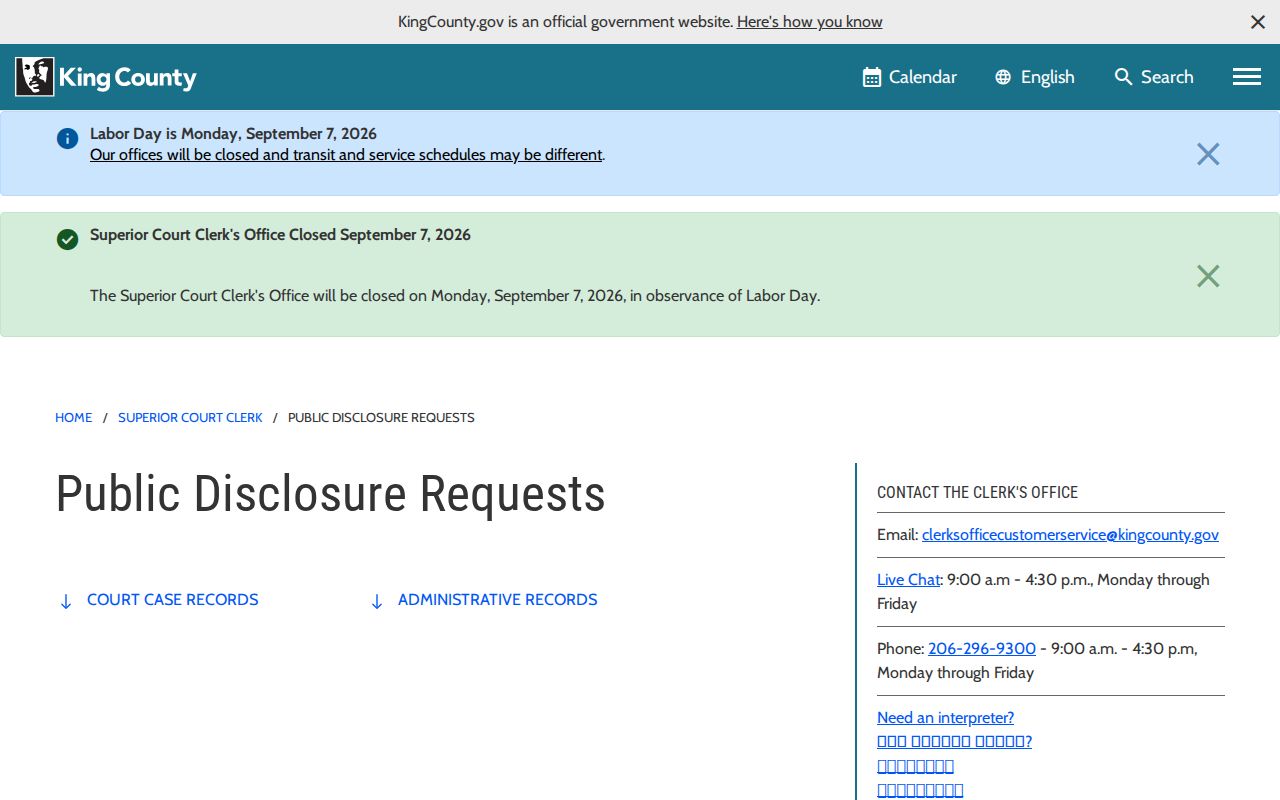
The access choices matter when an online name hit lacks the document needed to verify it.
A separate conviction-history request belongs in Washington State Patrol WATCH, not in a court docket search.
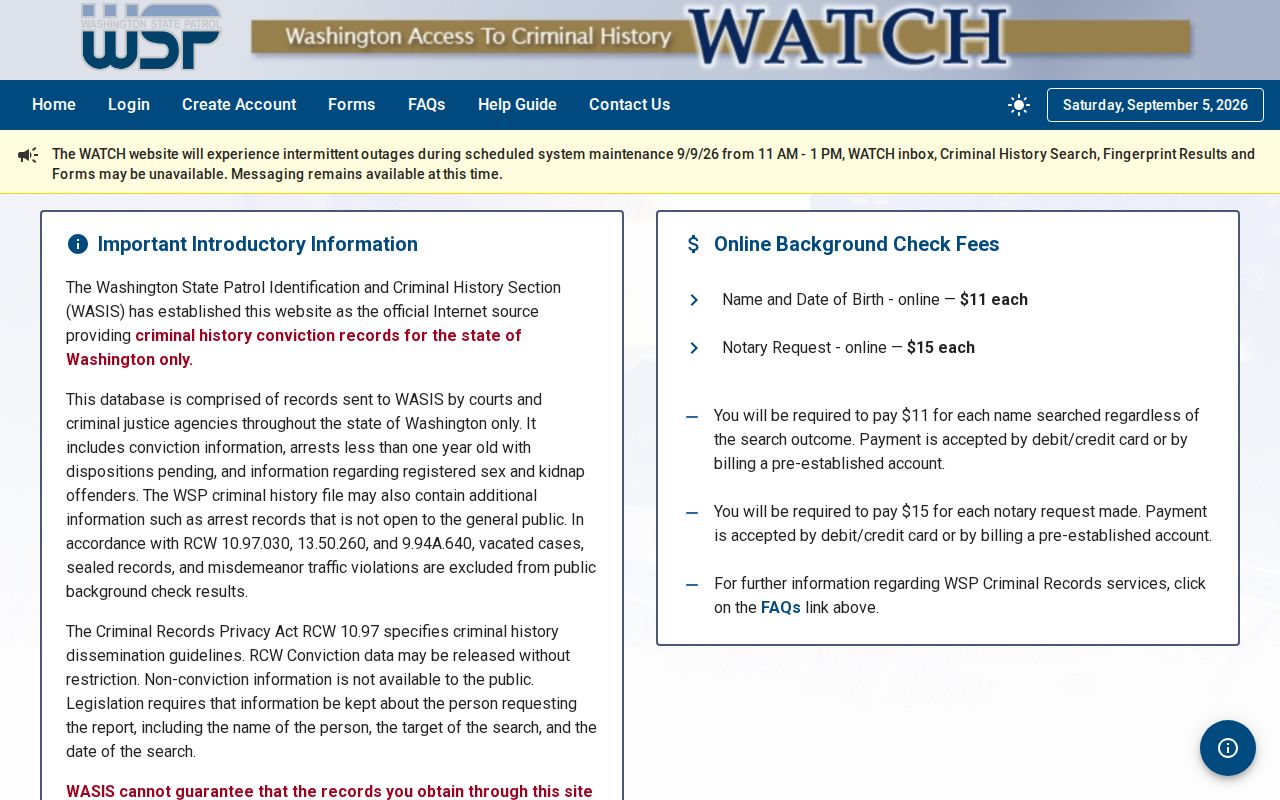
WATCH warns that a name and birth-date match does not positively identify a person; fingerprint verification is the stronger identity check.
Verify a Federal Way Resident
Build a short evidence trail before deciding that two records refer to one person. Names change, initials disappear, and a tax mailing address can differ from a parcel's situs address, which is the physical location assigned to the property. Record the date and custodian for each hit.
- Search the known address or owner name in King County eReal. Compare the mailing and situs fields rather than assuming the owner occupies the parcel.
- Run the court party search with the full name, variants, likely court, case type, and year. Save the case number for the clerk.
- Compare only lawful public voter fields or a historical vital index. Do not use a protected detail as a shortcut.
- Order a certified copy from the custodian only when formal proof is needed. Keep an informational copy labeled as such.
This resident lookup method also explains conflicts. An owner record may be old, a voter record may have changed county, or a court case may belong to a namesake. A second independent date, parcel, or case detail is far stronger than another copy of the same source.
Federal Way Vital Record Proof
King County Vital Statistics is the local registrar for births and deaths, while the Washington Department of Health maintains statewide certification routes. The Recorder handles marriage licensing and recorded marriage certificates. A divorce decree comes from the court, while DOH offers a separate dissolution certification.
Certified birth and death copies require a qualified applicant, identity proof, evidence of eligibility, and payment. Informational copies are available more broadly but have limited content and are not legal originals. The DOH FAQ listed $25 for birth and death informational copies when researched. Historical records generally transfer to State Archives after 100 years for births and fetal deaths and 25 years for deaths, marriages, and divorces.
Review the official vital-record route shown below at the DOH vital records page.
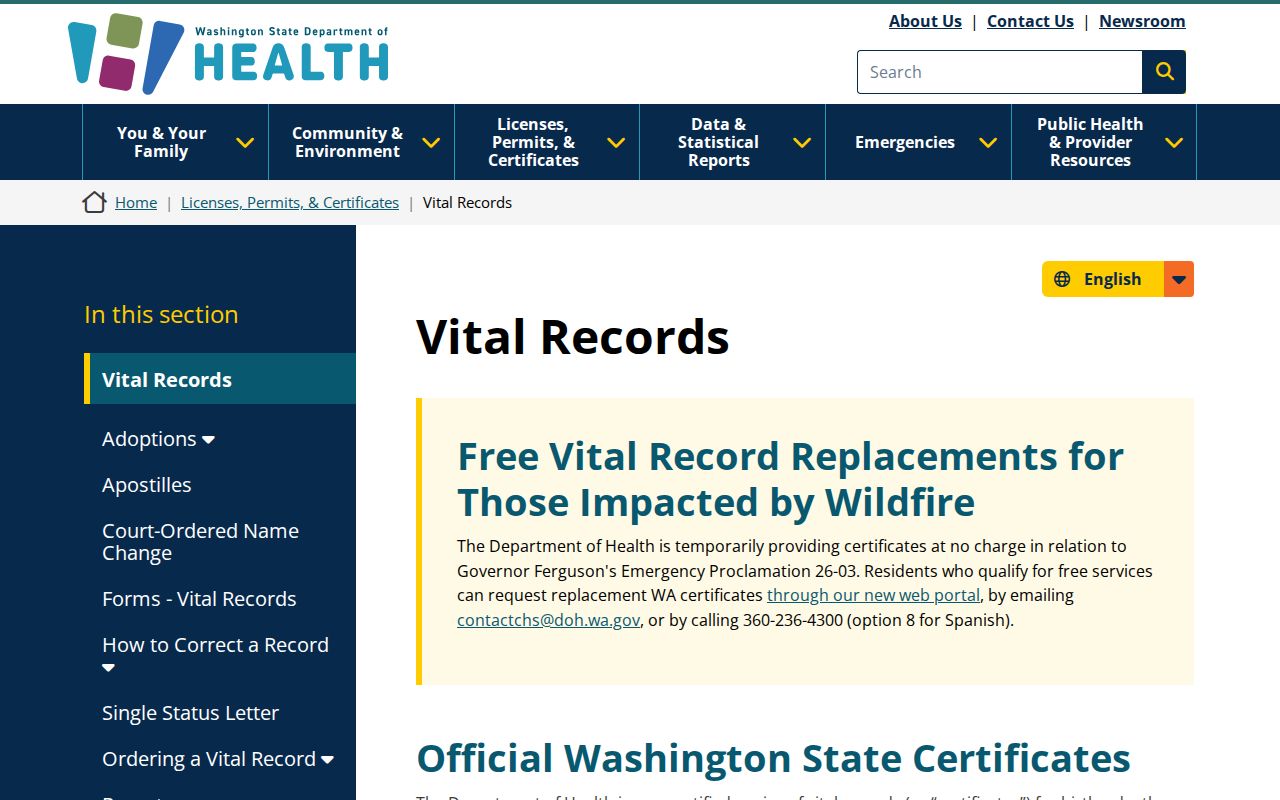
The ordering categories reinforce the difference between a current certified record and a historical index lead.
Federal Way Voter Record Limits
VoteWA is mainly a self-service system for a voter to check or update registration, view ballot status, and find election information. King County Elections administers Federal Way registrations locally. A broad public file request is a separate process, not a browse-by-name feature in the self-service screen.
Washington law allows disclosure of fields that include name, residence address, year of birth, and voting history. It withholds full birth dates, driver's-license numbers, Social Security number data, protected-voter records, and similar confidential fields. Washington does not register voters by party, and participation history never shows ballot choices. A non-match may reflect a move, name change, inactive status, cancellation, protection, or a record in another county.
The official interface can be reviewed through VoteWA.
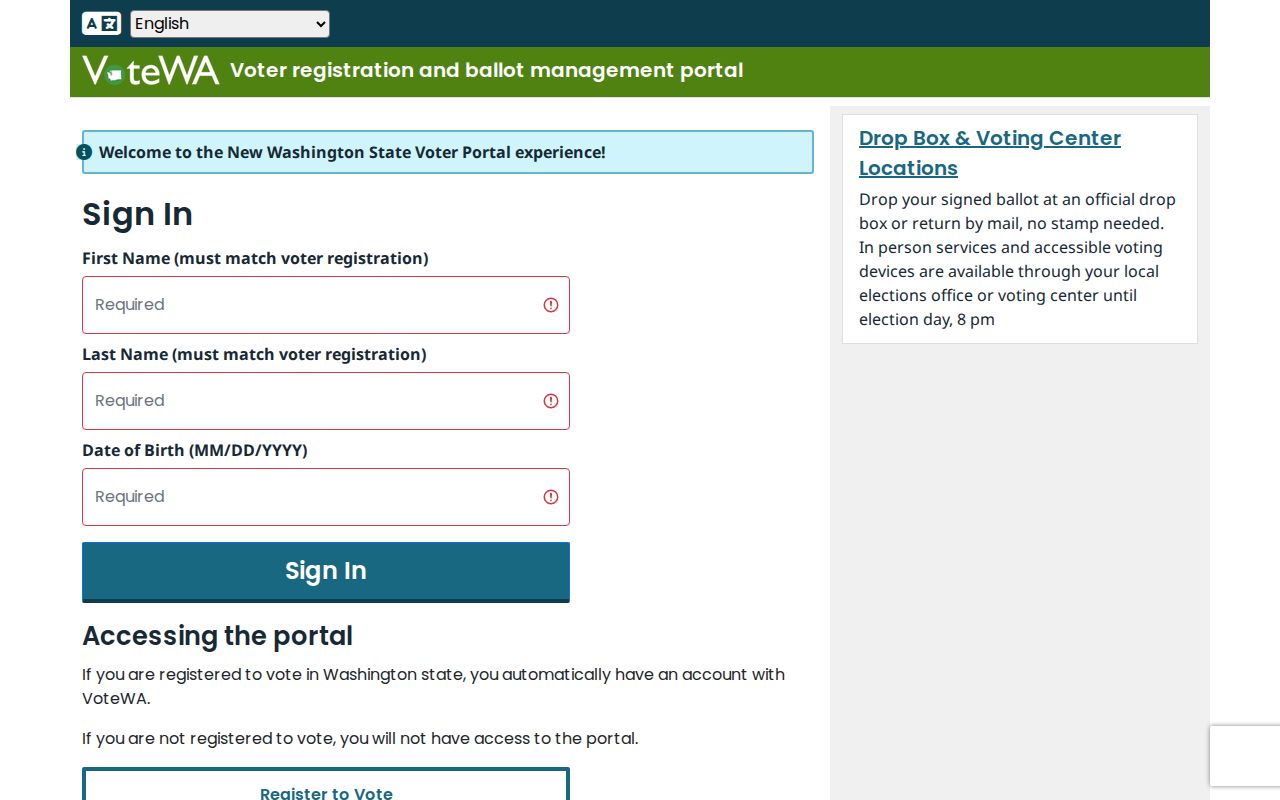
The voter-facing tools are useful for their stated purpose, but they are not a general public resident directory.
Note: A lawful request should name an existing report and desired fields; an agency does not have to create a new resident list.
Reconnecting Through Federal Way Records
Different goals require different official paths. An heir search may move from an obituary to a probate case and its personal representative. A former classmate is better traced through yearbooks, library databases, the Historical Society of Federal Way, and newspaper notices than through a same-name court result. Family research can use historical vital indexes after their release periods, county archives, and the Washington Digital Archives.
For a business owner, use the Secretary of State Corporations and Charities Filing System. It searches a business name or UBI and can expose entity status, formation state, registered agent, governors, and filing history. Professional credentials belong with the responsible state board. These are affiliation clues. A registered-agent address or license address does not prove current residence.
Open the official Washington Corporations and Charities Filing System before reviewing its search screen.
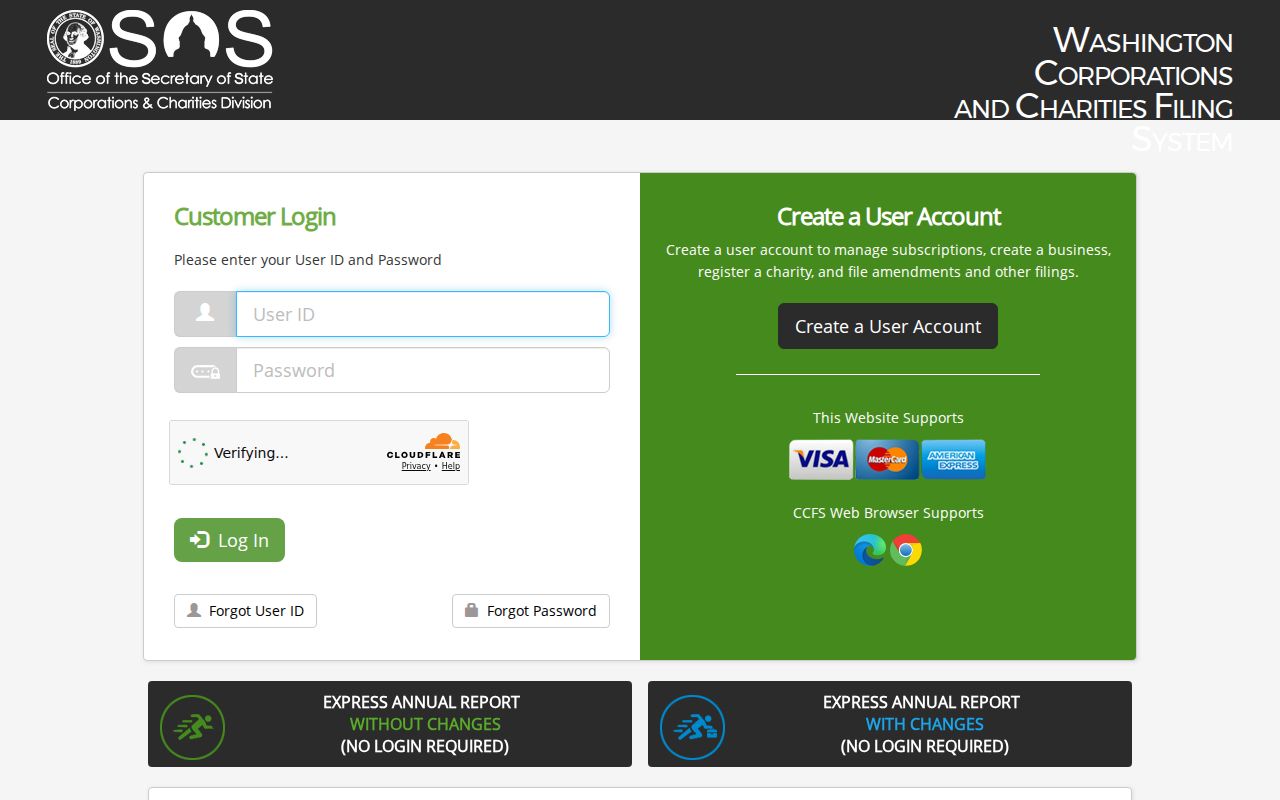
The entity search separates a public business affiliation from any claim about where an individual currently lives.
For a contractor or trade credential, start with the official Washington Labor and Industries Verify tool.
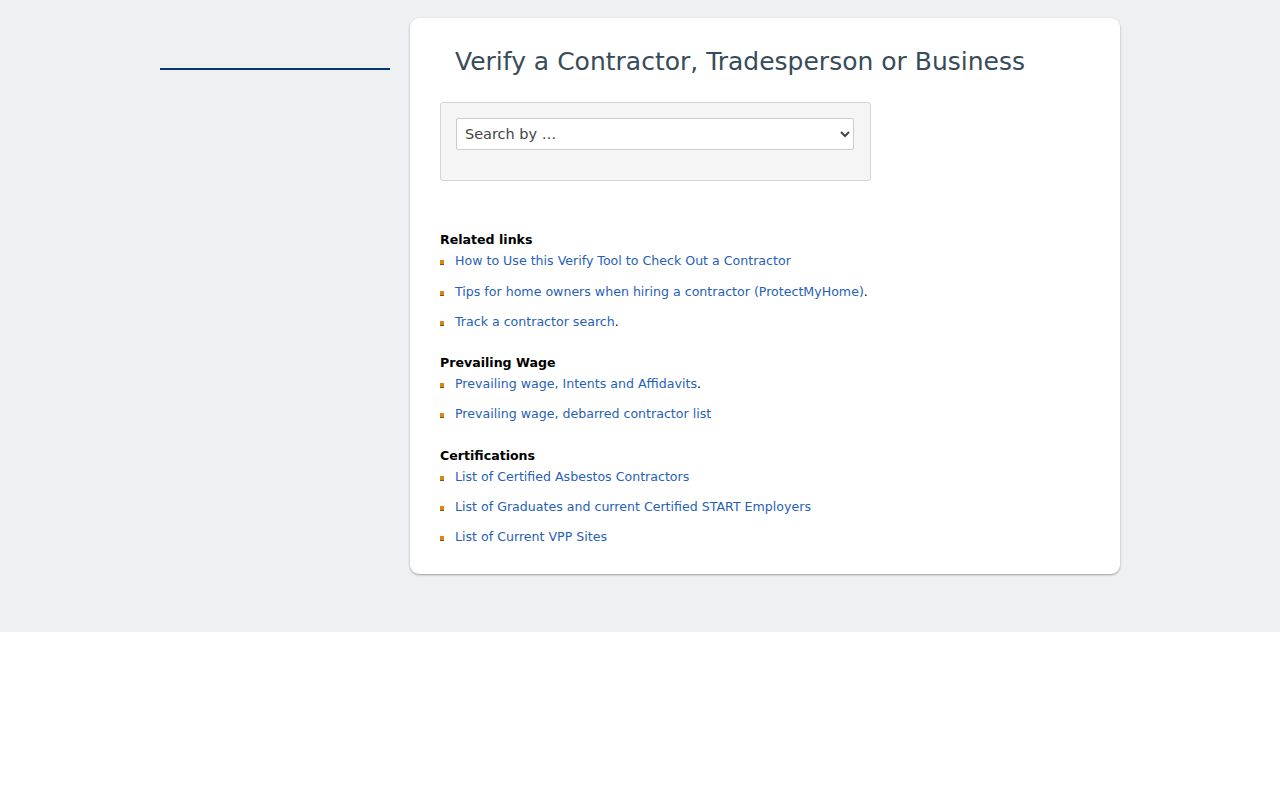
The verification result can confirm registration or status, while its contact fields remain business clues rather than residence proof.
The human value is in careful linkage. Probate, obituary, and historic directory sources can reconnect relatives or former classmates, but each step still needs a date, place, and name variant that distinguishes one person.
When Federal Way Search Ends
The official trail may stop because a renter is absent from property rolls, a voter has protected status, a court file is sealed or juvenile, a vital copy is restricted, or the record predates online coverage. The sound fallback is a narrow request for an identifiable existing record. Include the full name, address, parcel or case number, record type, and date range.
Federal Way city records use the city's request portal for city-held material. County court, assessor, election, recorder, and archive records go to their own custodians. The Washington Public Records Act calls for a prompt initial response, normally within five business days, but it does not override a separate confidentiality law or force an office to create a new list.
Commercial people-finder products blend public, purchased, and self-reported data. Their entries may be stale, merged, or hard to correct. Use an official record to verify any lead, and contact the source custodian when a government record itself is wrong.
Federal Way Resident Lookup Limits
Safe at Home gives eligible Washington participants a substitute address for public-record use, and program records are exempt from disclosure. Protected-voter rules, vital eligibility, sealed and juvenile court limits, and restrictions on driver data close other paths. Never try to reconstruct an actual address from a substitute address or combine partial records to defeat a safety protection.
Public availability is not permission to monitor, repeatedly contact, threaten, or expose someone. RCW 9A.46.110 addresses stalking and RCW 9A.46.020 addresses harassment. A correction also belongs with the office that owns the record: assessor for parcel data, elections for voter data, the filing court for a case, and the relevant licensing board for a credential.
Lawful use. A Federal Way resident lookup supports lawful personal, family, civic, and safety research. Never use a result to stalk, harass, intimidate, or harm anyone.