
Federal Way Previous Residents Sources
A backward address trail needs sources that overlap. The current parcel gives a stable PIN and legal description. Deeds name parties to land transactions, while permits date work at the site. Directories and census schedules can add occupants who never held title. Newspaper and probate material may explain a death, inheritance, or move. Coverage depends on the era and the geographic label used for Federal Way.
| Historical source | Documented span | Custodian or collection | Evidence it adds |
|---|---|---|---|
| Recorder general index | Most documents from August 1, 1991 onward | Landmark Web | Names, instrument type, date, legal description and image |
| Recorder parcel mode | 1997 to current | Landmark Web | Documents tied to the first ten parcel digits |
| Older recorded documents | Before August 1, 1991 | King County Archives microfilm | Deeds, liens, mortgages and other instruments |
| Federal Way permits | 1990 to current | City Permit Center and request portal | Project, address, application, issue and inspection history |
| Historic county permits | Before February 1990 | King County Permitting | Older site and building records |
| Regional directories | Seattle run 1890 to 1990; reverse lookup from 1938 era | Seattle Archives, SPL and UW | Occupant, address and occupation when the volume covers the area |
| Federal census | Released through 1950 | NARA, Census and library databases | Household, relationship, age, birthplace and occupation |
| Federal Way News | 1979 issues visible online | Historical Society of Federal Way | Obituaries, announcements and local names |
For a recent transfer, begin with eReal and Landmark. For a pre-1991 ownership trail, plan on Archives microfilm. To identify who occupied the place rather than who owned it, test reverse directories and the released census closest to the deed or permit date.
Start Federal Way Resident Records
Search the modern site address in King County eReal Property. Save the situs address, taxpayer mailing address, ten-digit parcel number, legal description, subdivision, lot or block, recent sales, and jurisdiction. The situs is the property location. The mailing address is where the tax notice goes and may be elsewhere.
Next, open King County Parcel Viewer. Its address, PIN, and condominium-name searches help confirm the parcel geometry, adjoining land, and Property Report. A house can stand on land that was divided or combined, so the current street number alone may not carry a search far into the past. Parcel lines in the viewer are approximate, and the recorded plat or survey controls when the boundary matters.
Open the official assessment search to see the current property-record entry point.
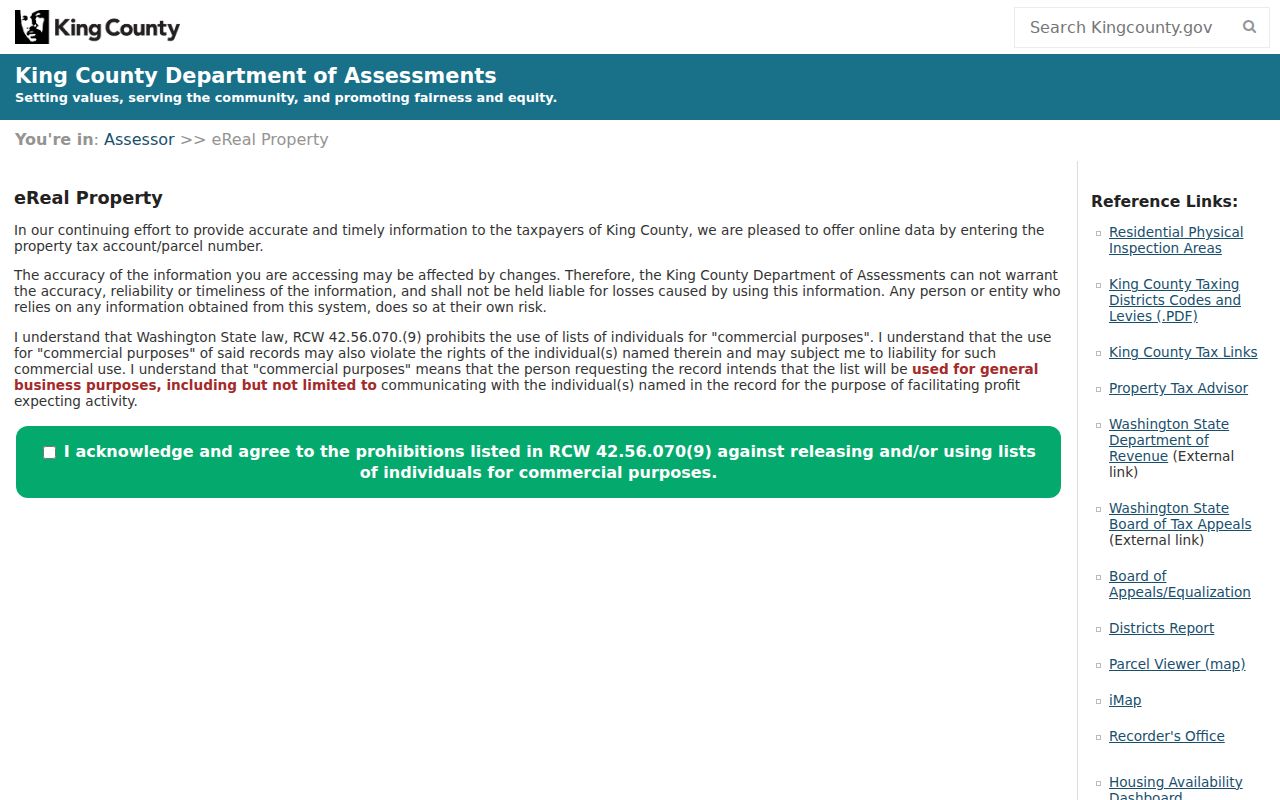
The assessment screen supplies the parcel identity needed before a previous-residents search can move backward into deeds and old maps.
Trace Federal Way Resident Records
A chain of title is the linked series of recorded transfers for the same land. King County's Recorder index does not accept a street address, so use the parcel and current owner first. Parcel mode covers 1997 forward. Most documents from August 1, 1991 are online, but the years before parcel mode may require name, legal, book-and-page, date, or recording-number searches.
- Copy the current owner's name and exact legal description from the Assessor report. Record the parcel and subdivision data too.
- Search Landmark Web for the current purchase deed. Note the recording number, date, document type, grantor, grantee, and legal description.
- Take the seller, who is usually the grantor, and search that person as a grantee in an earlier date range. Confirm the same legal description before linking the transfer.
- Repeat with name variants and middle initials. Reapply sorting and filters on every Landmark result page because they do not persist.
- At the online cutoff, contact King County Archives for microfilm research. Archives offers remote consultation and duplication, though original holdings do not circulate.
- Grantor and grantee
- The grantor transfers a recorded interest. The grantee receives it.
- Chain of title
- The sequence of documents that links present ownership to earlier transfers of the same land.
- Legal description
- The lot, block, subdivision, condominium, survey, or metes-and-bounds language that identifies land more firmly than a street label.
An index image is not a certified true copy and the public index is not a title opinion. The Recorder provides paid certified or uncertified copies online, phone orders at 206-477-6620, mail requests, and an in-person counter at 201 S. Jackson St. in Seattle. Certified online orders are mailed within five business days to preserve the seal.
Federal Way Records Cross Two Cutoffs
The most useful numbers in a past-residents search are 1991 and 1997. King County says most recorded documents from August 1, 1991 onward appear online. The Recorder tutorial gives 1997 to current for searches by the first ten parcel digits. That leaves an online period where names, legal descriptions, book and page, dates, or recording numbers may work even though a PIN search does not.
Before the 1991 line, use King County Archives. Its holdings include microfilm deed material, land and road maps, aerial photographs, 1880 to 1892 census volumes, Superior Court defendant indexes from 1865 to 1906, and recorded judgments from 1878 to 1969. Those sources can extend Federal Way research more than a century before city incorporation.
Note: Sort the trail by recording date, but compare execution dates and legal descriptions before assuming two documents represent consecutive transfers.
Federal Way Previous Residents in Permits
Deeds mark legal transactions. Permits can date construction, demolition, additions, repairs, land-use review, or inspections. Federal Way's city page identifies permit records from 1990 onward and sends pre-February-1990 historical permits to King County Permitting. The split is important because incorporation created a city record layer over older county files.
The Permit Center links an E-Permits Archive for certain residential electrical, mechanical, plumbing, and commercial electrical records. For other files, ask for the exact address, PIN, permit type, project date span, document title, and report or reference number. City requests can be submitted through the preferred portal or by mail, email, fax, phone, or in person.
A permit applicant is not always the owner and is not proof of occupancy. Compare the permit's site and date to the deed chain. A first permit may help date a structure, while a later alteration can explain a change visible on an aerial image or assessment card.
Pair Federal Way Resident Snapshots
Owners are only part of the story. A reverse directory may give an occupant at a street address, and a released census may show the household, relationships, ages, birthplaces, and occupations. The documented regional Seattle directory run spans 1890 to 1990, with reverse lookup from the 1938 era, but a Federal Way address must be checked for actual inclusion in each volume.
- Search the nearest reverse directory by street and address. Test the community, postal city, county, and variant street form used at the time.
- Read the alphabetical entry for each name. Record the year, page, occupation, spouse notation, employer, and any owner or renter mark without guessing at abbreviations.
- Compare several directory years around 1930, 1940, or 1950. The 1950 census is the latest public decennial schedule under the 72-year release rule.
- Use census age, relationship, birthplace, and occupation to separate same-name people. Before incorporation, try precinct, township, or community labels.
- Return to the deed and permit chronology. Treat each source as a dated snapshot and note any gap rather than filling it with an assumed resident.
Full descriptions of the shelf and how its entries read are kept on the Federal Way city directory page. The previous-residents trail needs only the volumes that match the house, era, and names under review.
Federal Way News Resident Clues
The Historical Society's Federal Way News archive displays digitized 1979 issues. Announcements, obituaries, businesses, civic events, and addresses may place a person near a property date when a deed names only an owner. The visible issues do not prove that the complete run is online, so record the issue date and page for every finding.
The Historical Society holds thousands of images, clippings, ephemera, and a file-cabinet inventory covering local subjects. Office research is by appointment at 2645 S. 312th Street, Federal Way, with contact at 253-945-7842 or contactus@federalwayhistory.org. A research request should include the address, parcel, neighborhood name, likely family names, and the narrowest known date range.
Review the Historical Society of Federal Way collections page before sending a focused request.
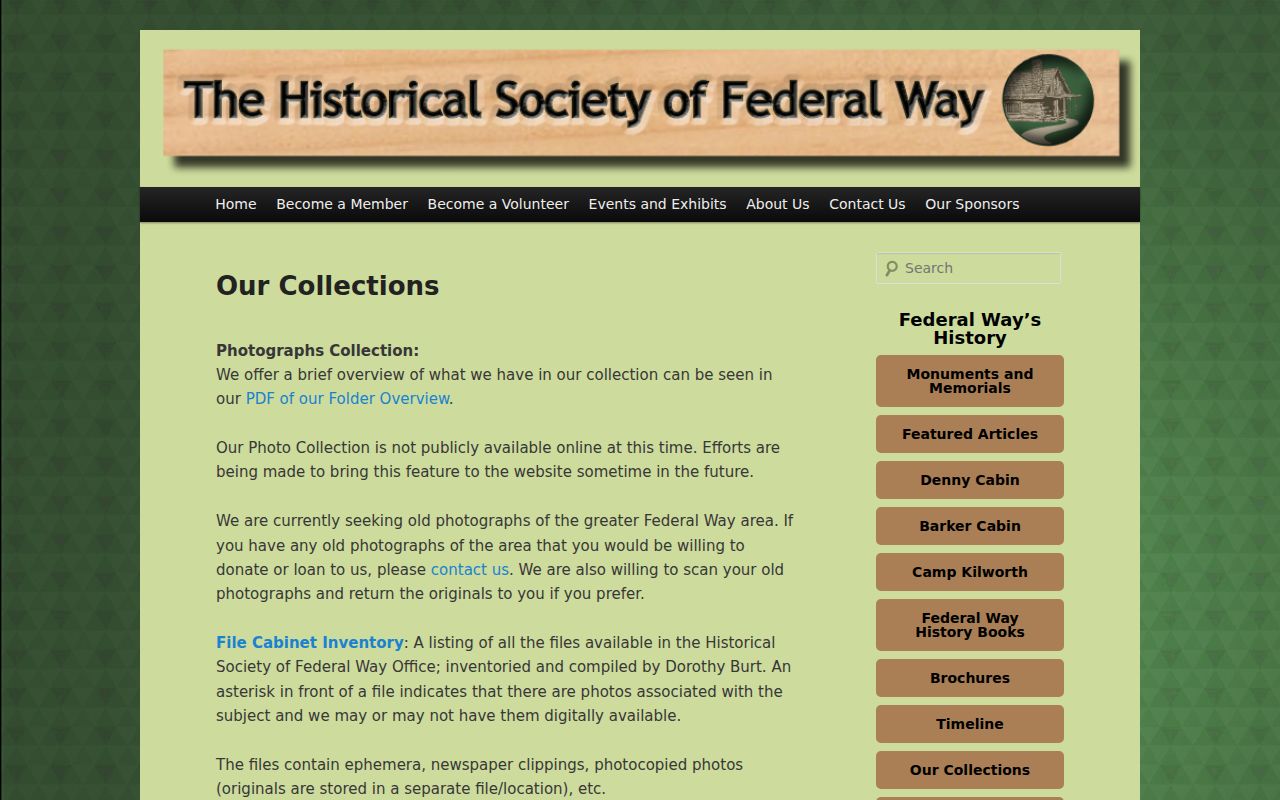
The local collection adds neighborhood names and personal context that are often absent from a parcel or deed index.
Salvaged Federal Way Library Records
Federal Way 320th Library has its own preservation story. KCLS records that the branch opened in 1970, suffered an arson fire in 1975, moved salvaged material to Federal Way High School, and reopened in 1976. That history does not prove a complete local directory run survived, but it explains why researchers should verify holdings instead of assuming continuous shelves.
Ask KCLS staff for local-history referrals, then check Seattle Public Library, the University of Washington, Seattle Municipal Archives, King County Archives, and the Historical Society. The official Seattle property-history guide is useful as a method source for King County buildings, but its Sanborn and permit references do not prove Federal Way coverage. No Federal Way-specific Sanborn volume was located in the reviewed official sources.
Older Federal Way Resident Records
Federal Way's name entered public use with a 1929 school-district consolidation, while city incorporation came in 1990. A previous-residents search before those dates may be indexed under unincorporated King County or a local name such as Redondo, Dash Point, Five Mile Lake, Lakota, or a school-district area. Search the legal parcel for title, but use the period place name for news, directory, census, photo, and subject-file research.
No official source reviewed established a citywide Federal Way street-renumbering year. When an address stops appearing, compare plats, county road maps, GIS address points, USPS formatting, directory street indexes, and aerial photographs. A subdivision or parcel change may be the cause. Preserve the uncertainty until a map or recorded instrument links the forms.
Watch the Federal Way Parcel
King County's free Recording Activity Notification System adds a current endpoint to house history. RANS can send email when a new land-record document matches a subscribed personal name, business name, or parcel. The county highlighted the service in 2026, and parcel registration uses the first ten PIN digits.
RANS does not stop a filing and is not a guarantee against fraud. It is an alert to inspect the recorded instrument. Once the correct Federal Way parcel has been established, the service can help a present owner notice new activity while the historical chain remains documented in Landmark and Archives.
Confirm Federal Way Previous Residents
A past owner is not automatically a past occupant. Confirm previous residents by comparing a reverse directory or census entry with the deed dates, permit events, newspaper references, obituaries, cemetery records, and probate files. Probate may name heirs and addresses, but it is a court file with its own access rules. A newspaper notice may report an event without proving that the person occupied the parcel for the whole year.
Use at least two dated sources for a strong household claim. Name variants matter, especially married names, initials, and spelling changes. A directory gap can also reflect a coverage boundary rather than a move. State the source year and what it actually says. That method allows family historians and heirs to reconnect a person to a Federal Way place without turning a loose name match into identity proof.
Lawful use. Federal Way previous-residents research is appropriate for house history, genealogy, heirs, and personal curiosity. Never use it to track, stalk, harass, intimidate, or harm a living person.
Protected addresses, sealed files, and unreleased census schedules remain outside the public trail. Respect those boundaries. The best final product is a source log with dates, citations, conflicts, and gaps, not a claim that the record system can name everyone who lived there.